LiveKit Cloud’s Agent Observability makes it easy to understand and improve how your agents behave on real calls. Across all turns, you get detailed traces, logs, and transcripts for every session, all laid out in a single correlated timeline you can replay. Deep visibility into user behavior is an important part of observability, but so is the ability to make certain details invisible to protect your users and project compliance.
Today we’re adding a new feature to Agent Observability: PII Redaction. Turn redaction on and you can automatically redact details like names, addresses, birthdays, and many other categories of sensitive information before recordings and transcripts are stored in the Agent Observability feature.
We believe that comprehensive observability is a critical component to building and scaling an agentic business, which is why we’re making this feature available at no extra cost to all customers using LiveKit Agent Observability.
How redaction works in LiveKit Agents#
Most existing PII redaction products rely on pattern matching: a regular expression for something shaped like a card number, a dictionary of known names, or traditional sequence-labelling models trained on formal text. Voice conversations are much more challenging and often have unique shapes: People spell things out loud, split them across turns, and correct them mid-turn.
To solve for this and reliably remove personal information from conversation recordings, LiveKit uses an LLM to read each conversation in context exactly the way a human redaction professional would. This approach allows us to reliably detect many different kinds of PII in varied contexts through the conversation.
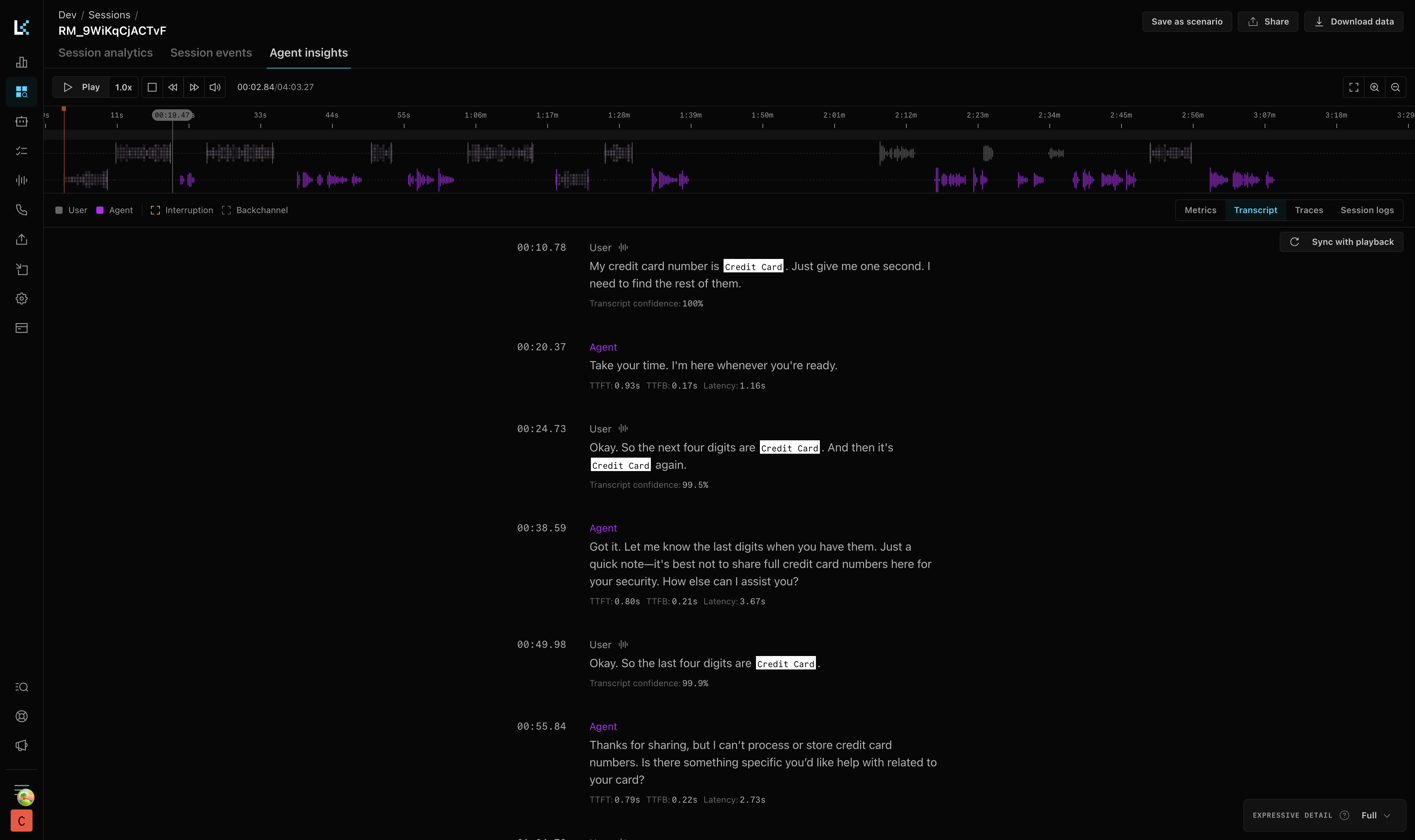
Once PII has been detected, the redaction engine replaces individual words or symbols inside the text transcript with redaction markers. These indicate what was redacted (for instance, a phone_number) while still allowing the developer to see the surrounding context and fully understand the agent’s behavior. Additionally, any fields in traces or logs that may contain PII or are marked as potentially sensitive are automatically dropped.
Finally, the PII is removed from the audio recording. As word-level ASR timestamps are not perfectly reliable in all STT models, LiveKit employs the safer approach of removing the entire turn from the audio recording to ensure the PII is not stored. These turns will appear in the recording with a soft tone played instead of the original speech. As recordings and transcripts are synchronized in the Agent Insights view in LiveKit Cloud, it is easy to see exactly what was redacted and read the transcript while listening to the audio so the context is not lost.
How LiveKit ensures only redacted data is retained#
LiveKit Cloud employs a blanket Zero Data Retention (ZDR) policy across the entire runtime stack, which includes agent deployments, LiveKit Inference, realtime media, and all other components. Developers using these services to run their agents can easily ensure that no unredacted data leaks beyond the lifetime of a session.
The Agent Observability service itself employs a secure ingestion service, which is where agents send their unredacted recordings and transcripts first. This service runs the redaction model, as configured in the project’s settings, before forwarding the final redacted artifacts into the Agent Observability storage system. From there, the records are retained for 30 days and made available to the developer through the Agent Insights feature in the LiveKit Cloud Dashboard. All Observability data is automatically deleted after 30 days.
Available redaction categories#
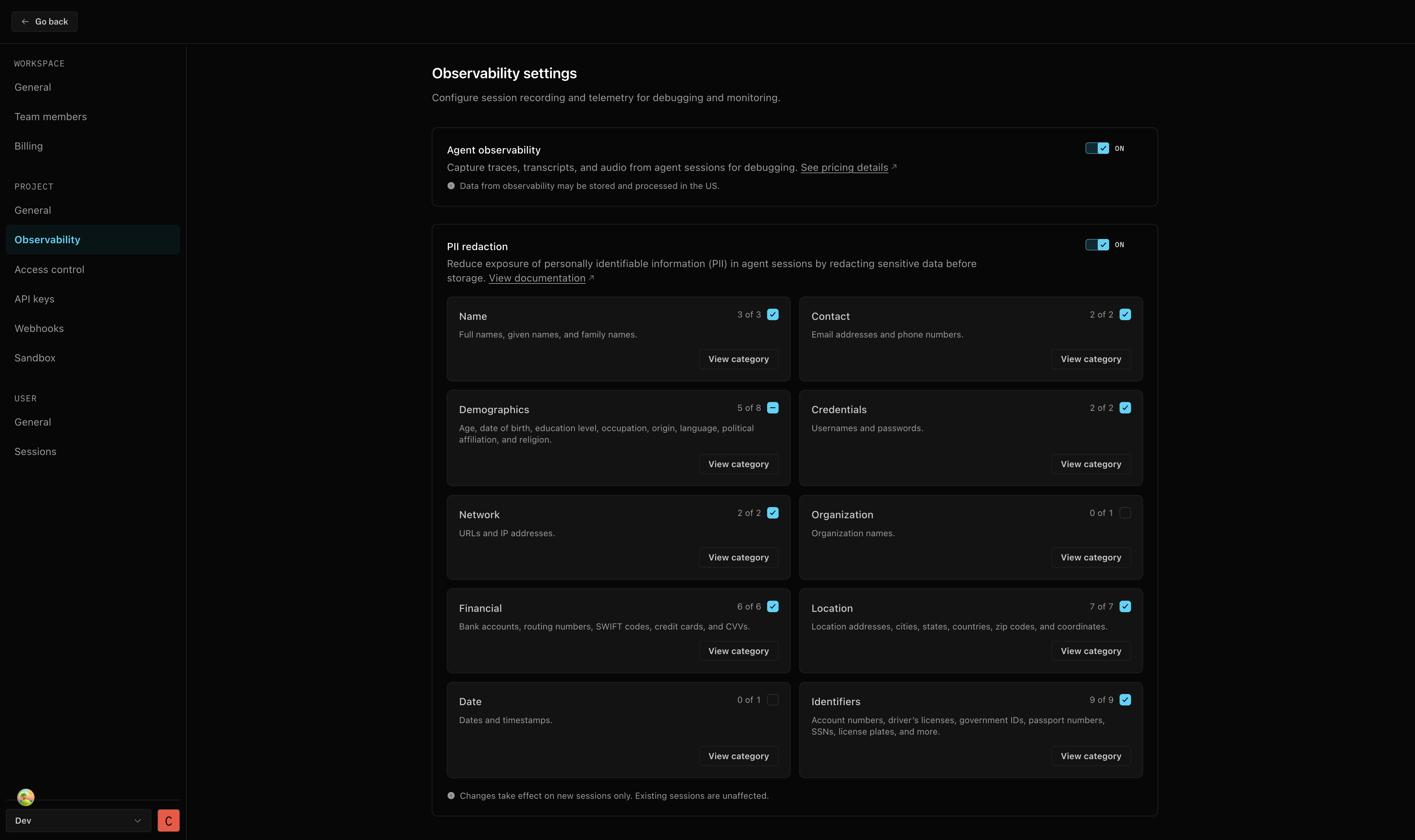
Today we support redaction of 41 different kinds of PII, across 10 different groups:
- Name: full, given, and family names
- Contact: email addresses and phone numbers
- Demographics: age, date of birth, occupation, and more
- Credentials: usernames and passwords
- Network: URLs and IP addresses
- Organization: company and org names
- Financial: bank accounts, routing numbers, cards, CVV
- Location: addresses, cities, coordinates, and more
- Date: calendar dates
- Identifiers: SSNs, passports, driver's licenses, government IDs, and more
You can choose which to enable on your project, according to your needs. Most are included by default when you turn on PII Redaction and the others can be enabled as needed.
Getting started#
PII Redaction is available to all customers using the latest version of the LiveKit Agents SDK (Python version 1.7.0, Node.js version 1.7.0).
To get started, follow these steps:
- Navigate to Project Settings → Observability for your LiveKit Cloud project
- Ensure that Agent Observability is turned on
- Enable PII Redaction and choose the desired redaction categories.
PII Redaction will start working immediately on all future sessions sent to Agent Observability.
For more information, see the documentation and don’t forget to share your feedback in the LiveKit Community.